The 32-Year Paper Chain
6 min read
Let's be honest for a second. If you're looking at land on the outskirts of Hyderabad right now, a farm plot along the RRR belt, an open plot in a growth corridor that everyone's suddenly talking about, the numbers look genuinely exciting. The infrastructure is real. The appreciation thesis makes sense. And the urge to just book something before prices move is completely understandable. But here's what the glossy brochure won't tell you: the land market on the periphery of this city is a legal minefield. And the people who get hurt aren't naive. They're often the most research-oriented buyers in the room.
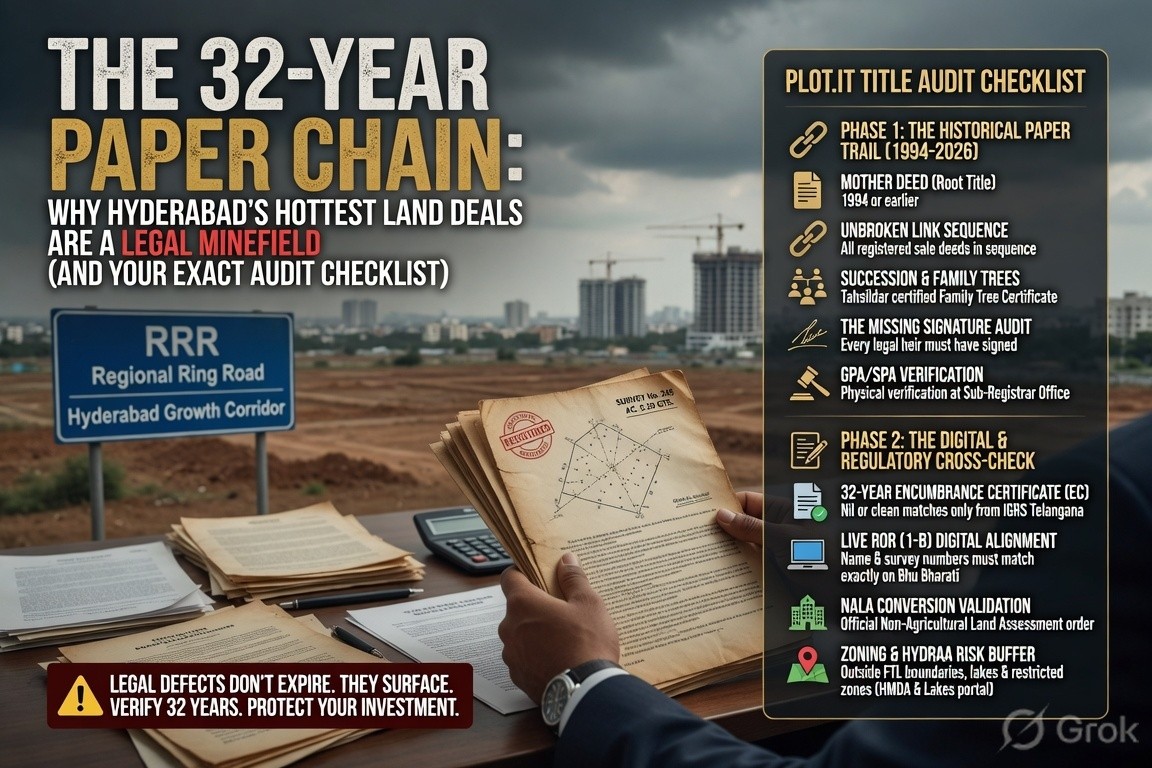
The Mistake Smart Buyers Are Still Making
Picture this: someone spends weeks doing their homework. They check the Bhu Bharati portal, see the seller's name sitting clean on the screen, run a quick title check, and feel good about the deal. They transfer the booking advance. Two years later, a distant relative of the original landowner shows up with a 1998 partition deed that nobody knew about and one signature was missing. Court date: pending.
This isn't a rare horror story. It's a pattern.
Digital land registries are convenient, but they're ultimately just data-entry systems. They reflect what was inputted. They don't erase historical legal defects. And a title check from 5 years ago? Useless. Land dynamics in a fast-moving market shift faster than most legal records get updated.
To actually protect yourself, you need to look backward! Specifically, an unbroken 32-year link document flow from 1994 to today. Why 1994? Because three decades of ownership history is where you catch the generational transfers, ancestral splits, and overlooked heir claims that short-term checks completely miss.

The Plot.it Title Audit Checklist
Before you move a single rupee, put this in front of your seller or developer. If they hesitate on any of it, that hesitation is your answer.
Phase 1: The Historical Paper Trail (1994–2026)
This is your Paper Chain. You're looking for one thing: a completely unbroken, logically sequenced ownership history.
Mother Deed (Root Title) - Find the foundational registered document from 1994 or earlier. Does it clearly define the boundaries? Is it recognized as undisputed private Patta land? This is the starting point of everything. If the root is shaky, nothing built on top of it is safe.
Unbroken Link Sequence - If the land changed hands three times between 1994 and now, you need all three registered sale deeds. The buyer in Deed A must be the exact seller in Deed B. A single gap in that chain is enough to invalidate your ownership claim in court.
Succession & Family Trees - If the land passed through inheritance at any point, get the Family Tree Certificate certified by the local Tahsildar. Inheritance is where most hidden disputes are buried literally for decades.
The Missing Signature Audit - Go through every partition deed with a fine-tooth comb. Did every legal heir sign - including daughters, including siblings who may have moved away? One missing signature from a relative in 1998 can become a civil suit filed against you in 2026. You didn't create the problem, but you inherited it the moment you bought.
GPA/SPA Verification - If any transaction in the chain was executed through a General Power of Attorney, physically verify it at the Sub-Registrar Office. Confirm the GPA was legally valid and that the principal was alive on the exact date of that specific registration. This one catches more fraud than almost anything else on this list.
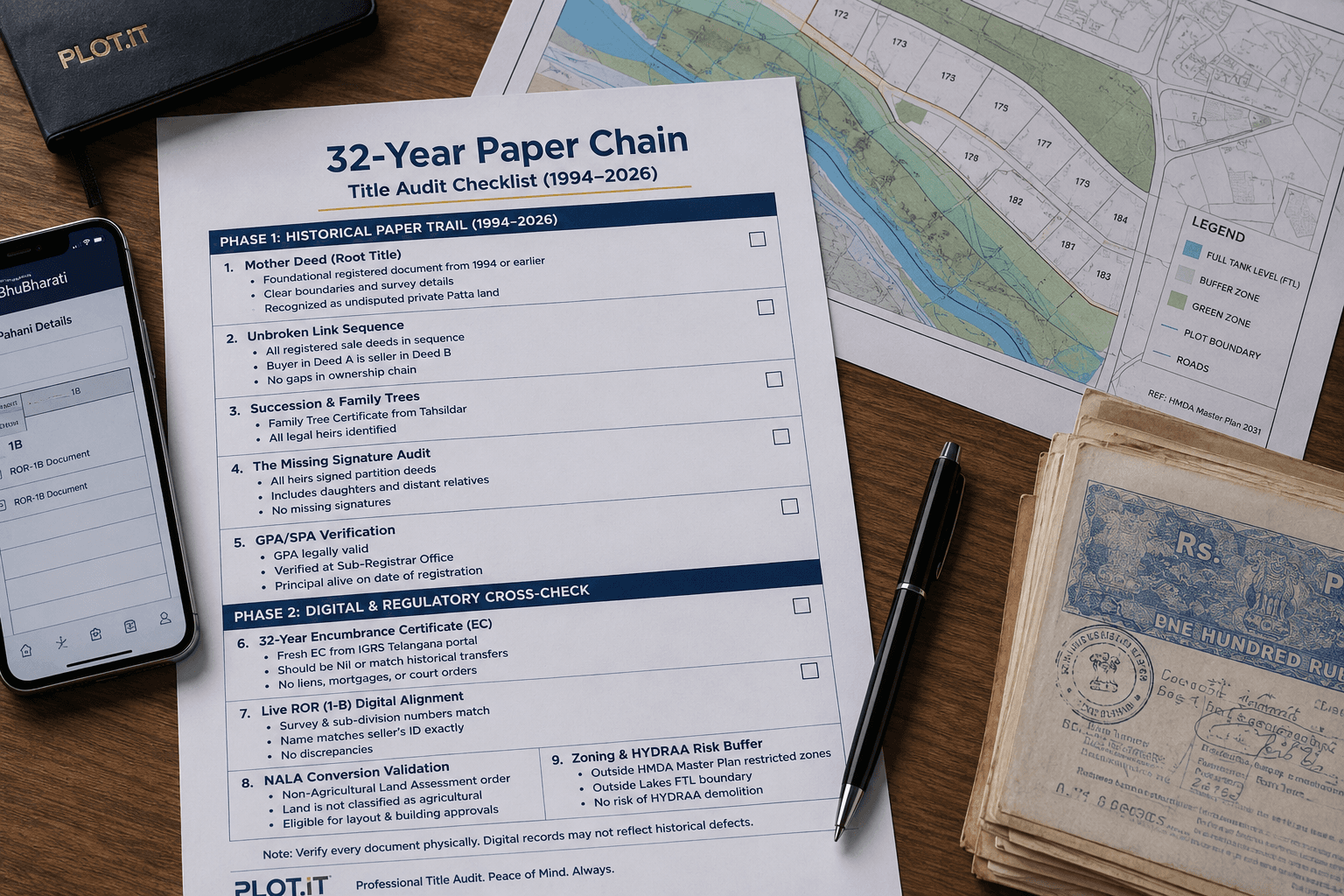
Phase 2: The Digital & Regulatory Cross-Check
The paper chain checks out? Good. Now make sure the government's live systems agree with what the paper says.
32-Year Encumbrance Certificate (EC) - Pull a fresh EC directly from the IGRS Telangana portal. It should return Nil, or show only the clean historical transfers that match your link deeds exactly. Any banking lien, private mortgage, or court stay order hiding in there is a dealbreaker, not a negotiating point.
Live ROR (1-B) Digital Alignment - Cross-check the survey and sub-division numbers on Bhu Bharati. The name on the portal must match your seller's physical ID documents exactly. A mismatch here isn't a paperwork technicality. It's a red flag with a capital R.
NALA Conversion Validation - Does the land have an official Non-Agricultural Land Assessment order? If it's still classified as agricultural on the portal, you won't be able to get layout permissions or building approvals later. You'd own land you legally can't develop.
Zoning & HYDRAA Risk Buffer - Cross-reference the survey coordinates against the HMDA Master Plan and the Lakes portal. The plot needs to sit entirely outside any water body's Full Tank Level boundary or restricted green zones. HYDRAA demolitions are not hypothetical. They're happening.

When you buy land 100 kilometers outside the city core, you're not just buying physical space. You're buying the legal history of that space: every transfer, every family dispute, every signature that was or wasn't there.
Promises don't hold up in a land dispute. Paper does.
Run this checklist like you're doing institutional due diligence, because in terms of the capital at stake, you are. The investors who come out ahead in markets like this aren't the ones who moved fastest, they're the ones who verified hardest.
Bookmark this. Share it with whoever you know who's looking at land right now. And if you want Plot.it to run this audit for your next site, you know where to find us.
Stay in touch
Stay updated with the latest news and insights from Plot It.