Top 3 Corridors at RRR Belt that will Boom in Next 5 Years
4 min read
A Plot it buyer guide: July 2026

First, the one line that changes everything
In March 2025, the Telangana government issued GO Ms. No. 68 and quietly did something huge: it extended the Hyderabad Metropolitan Region boundary all the way out to the Regional Ring Road — plus a 2 km buffer outside it, officially labelled the RRR Growth Corridor.
HMR jurisdiction now covers 1,355 villages across 11 districts, roughly 10,472 sq km.
Translate that into buyer language: land that was "village land" two years ago is now inside Hyderabad's official planning boundary. Layout approvals, master plan zoning, road widths, infrastructure budgets — all of it now flows to this belt.
This is the exact moment ORR was at in 2005–2008. Aa time lo evaru "city ki chaala dooram" annaro, vaalle ippudu regret chestunnaru.
But before the top 3 — one honest warning
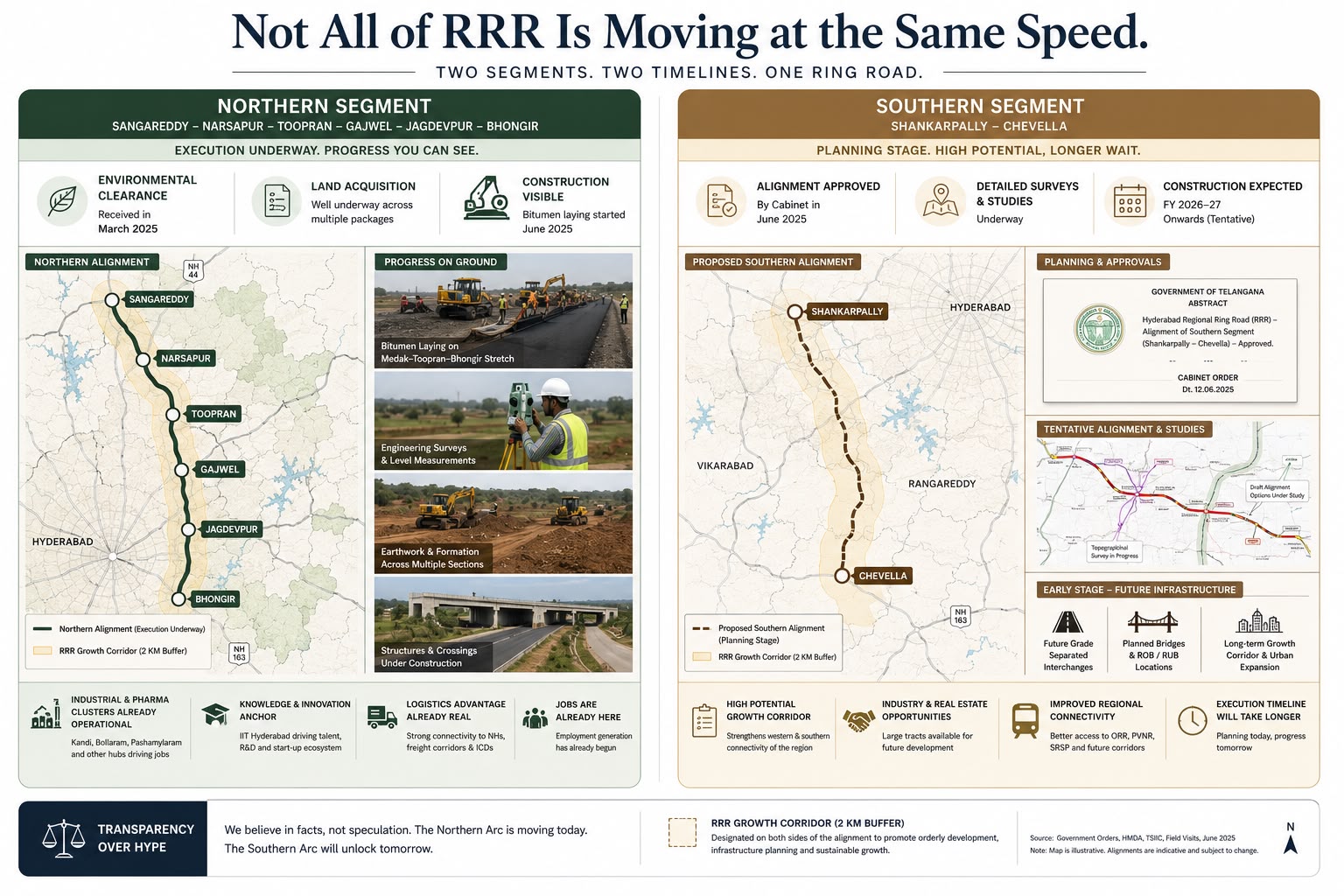
The RRR is not one project. It is two very different projects wearing the same name, and confusing them is the single most expensive mistake buyers are making right now.
Northern Arc | Southern Arc | |
|---|---|---|
Length | ~164 km | ~182 km |
Route | Sangareddy → Narsapur → Toopran → Gajwel → Jagdevpur → Bhongir → Choutuppal | Choutuppal → Ibrahimpatnam → Kandukur → Amangal → Chevella → Shankarpally → Sangareddy |
Environmental clearance | Received (March 2025) | In process |
Land acquisition | Largely done — compensation already disbursed in Medak & Yadadri | In progress |
Physical work | Bitumen laid on Medak–Toopran–Bhongir stretch since mid-2025 | Not started |
Realistic timeline | Phased opening from 2026–2027 | 2028–2030 |
North = execution certainty. South = potential with a longer wait.
Both can make money. But they are not the same risk, and they should not be the same price. If a marketer quotes you northern-arc rates for southern-arc land, that's your red flag.

Corridor #1 — Sangareddy → Narsapur → Toopran (North-West arc)
Why this one is first: jobs already exist here.
Most "growth corridor" stories are built on a road that hasn't opened yet. This one isn't. The Sangareddy belt already has real, running employment — the Kandi–Sadasivpet industrial base, the pharma and manufacturing clusters at Bollaram, Gaddapotharam and Bonthapally, and IIT Hyderabad at Kandi.
The RRR doesn't create demand here. It unlocks demand that's already stuck in traffic.
What's driving it:
Sits on NH-44 (Nagpur highway) — the strongest existing spine in the whole ring
Industrial employment base means end-user demand, not just investor churn
Land acquisition here is among the most advanced on the northern arc
ORR-to-RRR radial connectivity via the Medak highway is already functional
Who this suits: Buyers who want the lowest execution risk in the belt, and who value a working local economy over a story.
Watch out for: Land immediately adjacent to industrial estates. Cheap for a reason — check pollution zone classification and downwind position before you fall in love with the price.
Corridor #2 — Gajwel → Jagdevpur → Bhongir / Bhuvanagiri (North-East arc)
Why this one is second: this is where the road is actually being built.
Bitumen laying began on the Medak–Toopran–Bhongir stretch in mid-2025. If you want to physically stand on RRR tarmac in 2026, this is where you go. Nothing moves land value like a road you can see.
What's driving it:
Rajiv Rahadari (SH-1) is already a four-lane, high-speed corridor — Gajwel to Secunderabad is a genuinely comfortable drive today
NH-163 (Warangal highway) intersects the arc at Bhongir, giving it two spines instead of one
Yadadri temple economy — hospitality, weekend traffic, and a steady non-residential demand floor
AIIMS Bibinagar anchoring healthcare employment on the eastern edge
Gajwel has a decade of concentrated public infrastructure spending behind it
Who this suits: Weekend-home and farmland buyers. The Bhongir–Yadagirigutta stretch has landscape (the rock formations, the lake belt) that the western corridor simply doesn't have, and it prices lower per square yard.
Watch out for: Assured-return farmland schemes. This belt has the highest density of "managed farmland with guaranteed 15% returns" offers in Telangana right now, and most of them are agricultural land being sold at plotted-development prices.
Corridor #3 — Shankarpally → Chevella (West / South-West arc)
Why this one is third — and why it may still be the biggest.
Let's be straight about the timeline: this sits on the southern arc, which is behind the north on clearances and construction. If you need a return by 2028, this is not your corridor.
But over a 5–7 year horizon, this is the one with the highest ceiling — because it is the only stretch of the RRR that directly extends Hyderabad's existing growth engine.
What's driving it:
Direct continuity from Gachibowli → Financial District → Kokapet → Mokila → Shankarpally. The wealth corridor already points this way.
Shankarpally has shown the strongest sustained appreciation of any RRR-belt location over the last decade
Satellite IT and campus expansion is being actively explored toward Shankarpally and Chevella
Best existing social infrastructure in the belt — international schools, hospitals, retail already present
The 2026 market value revision has recalibrated official rates here, which signals that the government itself now recognises the market strength
Who this suits: Buyers with a 5+ year hold who want end-use optionality — plot it, build on it, or sell it. This is the only corridor where all three genuinely work.
Watch out for: Price. You're paying for a story that's already half-priced-in. And critically — verify GO 111 status on any parcel in the Chevella–Moinabad stretch. The zone was reworked, not erased, and buyers are still getting caught here.

The honourable mention: Choutuppal → Ibrahimpatnam
Not in the top 3 only because of timing, not potential. This is the junction where the northern and southern arcs meet, it sits on NH-65 (Vijayawada highway), and it's the natural connector toward the Future City / Mucherla zone in the south-east.
If the southern arc gets its central clearance and tender award in FY 2026–27, this corridor jumps straight into the top 3. Track it.
How to actually buy in this belt — the Plot it checklist
A corridor being "hot" protects nobody. The corridor makes your land appreciate. The paperwork decides whether you get to keep it.
Before you pay any advance:
Approval — HMDA / DTCP approved layout, LP number verifiable on the portal. Not "approval coming soon."
Distance from the actual alignment — get the survey number and check it against the notified RRR alignment. "RRR ki daggara" means nothing without a survey number.
Acquisition check — land inside the acquisition corridor gets compensation, not appreciation. Confirm your parcel is near the road, not under it.
Bhu Bharati record — verify ownership, extent and ULPIN on the Bhu Bharati portal. Pattadar passbook matching the seller's ID is non-negotiable.
NALA conversion — agricultural land needs conversion before non-agricultural use. Unconverted land sold as "plot" is a future problem, not a bargain.
EC for 30 years — encumbrance certificate, full period, no gaps.
Road width in the layout — 30 ft minimum internal, 40 ft approach. Narrow roads cap your resale forever.
Market value vs asking price — check the notified market value for that mandal. If the asking price is 4x the notified value, ask why.
The bottom line
The RRR belt will create wealth over the next five years. That part is now reasonably certain the boundary has been redrawn, the money has been committed, and on the northern arc the road is physically being laid.
What is not certain is whether you capture it. That depends entirely on whether you buy the corridor or buy the pitch.
Do the boring verification. The boring part is where the money is.
Stay in touch
Stay updated with the latest news and insights from Plot It.